

matchstick puzzle logoMORE MATCHSTICK PUZZLES...

OCT
07
#31

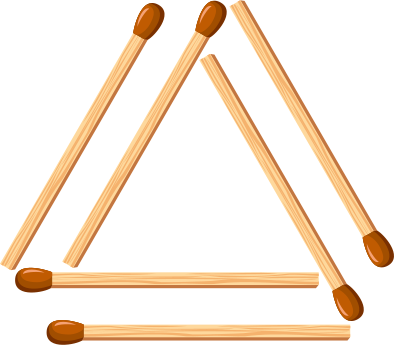
3 Triangles to 2

Move 2 matchsticks to end up with 2 equilateral triangles.

OCT
06
#30

Spiral to Squares

Move 3 matchsticks to make two squares. No loose matchsticks should remain.

OCT
05
#29

3 Triangles to 5

Move 4 matchsticks to form 5 equilateral triangles.

OCT
04
#28

Key to Squares

Two identical squares can be spotted in this shape. Move 4 matchsticks to get three squares.

OCT
03
#27

Windmill to 8 Triangles

Move 3 matchsticks to get 8 equilateral triangles.

OCT
02
#26

Divide the Shape

With the help of 2 matchsticks divide this figure into two congruent parts (equal in area and shape). They can be mirrored.

OCT
01
#25

Getting 4 Triangles out of 2

Move 3 matchsticks to get 4 equilateral triangles.

SEP
30
#24

Grid & Squares

Move 2 matchsticks to leave only 2 squares.

SEP
29
#23

Two Glasses: Empty & Full

One glass is empty, another one is full. Move 2 matchsticks to make two full glasses.

SEP
28
#22

Square & E

Ten matchsticks are arranged into the square and the stylized "E" letter. Move 3 matchsticks to get two squares.

SEP
27
#21

Fence to the Cross

Move 4 matchsticks to make a cross out of this fence.

SEP
26
#20

Square & Triangle to 3 Triangles

Move 1 matchstick to get 3 triangles.

SEP
25
#19

4 Squares to 2

Move 3 matchsticks to get 2 identical squares out of these four ones.

SEP
24
#18

4 Triangles from 3

Move 2 matchsticks to create 4 triangles of the same size.

SEP
23
#17

Coffee Table and the Chair

Move 3 matchsticks so that the chair is to the left of the coffee table.

SEP
22
#16

8-Cell Grid to 7 Squares

There are 8 small squares and 3 big ones in this grid. Move 2 matchsticks to get a total of 7 squares only.

SEP
21
#15

The Donkey

Move 2 matchsticks to make the donkey heading into another direction. Its current shape must be preserved, though it may be mirrored.

SEP
20
#14

Get 3 Equal Shapes

Move 4 matchsticks to create 3 equal shapes.

SEP
19
#13

Triangular Grid to Triangles

Move 4 matchsticks to make five equilateral triangles.

SEP
18
#12

Arrow to 8 Triangles

The figure shows an arrow formed of 16 matches. Move 7 matchsticks to get 8 EQUILATERAL triangles.

SEP
17
#11

Tic-Tac-Toe to Squares

Twelve matchsticks are arranged into the tic-tac-toe style grid. Move 3 matchsticks so that to get three identical squares.

SEP
16
#10

3 Squares from 5: V2

Move 4 matchsticks to make 3 identical squares, with no matchsticks left out.

SEP
15
#9

6 Triangles from 5 Diamonds

The composition consists of 5 diamonds - 4 smaller ones and a big one. Move 4 matchsticks to get 6 identical triangles.

SEP
14
#8

The Horse

The horse is firmly standing on the ground. Move 1 matchstick to make the horse standing on its hind legs, while fully preserving the horse's overall shape.

<

1

...

10

11

12

13

>

Puzzles with matchsticks are very popular today among both children and adults. They help a person develop logical thinking and attentiveness. Matchstick logic problem can be very different. Basically, the tasks require you to create some kind of image, number or geometric figure.


Matchstick modeling develops thinking. The main highlight of such problems is that the answer is usually not obvious. Moreover, sometimes at first glance it seems that it is impossible to solve the puzzle at all. It takes at least a few minutes of thinking in your head or with a pencil. Obviously, such exercises are useful for “pumping up” logic and developing spatial thinking in a child.


Matchstick riddles influence the imagination. By imagining what would happen if we move this or that matchstick, we develop the “imagination center” inside our brain. Matchstick puzzles improve short-term memory. This is especially true for those who solve such problems in their head, remembering intermediate results. Spending time solving puzzles encourages attentiveness and perseverance. Last but not least - concentration plays a key part as well.


Challenging yourself to solve a matchstick puzzle in the shortest timespan boosts your self-esteem. And then, challenging yourself to solve a really difficult problem, we feel more confident and stop giving in to difficulties ahead.


Our constantly expanding collection of interactive matchstick puzzles comes in different difficulty levels, making them suitable for both adults and children. You can return to your favorite puzzles many times and share them with friends and dear ones.


How to solve matchstick puzzles? It is clear that in each specific case the approach differs, but there are still general recommendations. The hint is often contained in the problem’s objective itself, so you need to read it very carefully. Analyze whether there is a “double bottom” or a catch in it. Prepare for the fact that the solution is not trivial - otherwise the task would not be called a puzzle. Often you need to move 1 matchstick to get one or another figure or a certain number of figures. Don't forget: several small shapes (for example, squares) can make up a large one. Take your time. Don't focus on getting through the exercise quickly. Consider your options carefully.


As a pleasant bonus, we would like to draw your attention to 7 interesting facts about matchstick production:

- a match that ends up in sea water will decompose within six months;

- the best material for making matches is aspen;

- the first matchboxes were made of metal;

- there are more than 100 types of matches in the world;

- about 30 billion matchboxes are produced annually on the planet;

- on average there are approximately 40 matches in a box. In the 19th century, the number reached 60 pieces;

- it turns out that an ordinary match can save a person from death if he is bitten by a poisonous karakurt spider. To do this, the bite site must be cauterized as quickly as possible, as a result of which the poison will disintegrate and will not pose any threat to the human.