Today's PUZZLE CLASSIC OF THE DAY

PREVIOUS 12 DAYS

What Speed to Choose?

Traveling at 60 mph will make you arriving an hour late. Traveling at 100 mph will make you arriving an hour earlier. What speed to choose to arrive on time?

The 3 Croutons’ Challenge

Grandma fries 3 croutons for her grandkid's breakfast. Each crouton takes 1 min to be fried on one side, but the pan is big enough just to hold 2 croutons. What is the shortest period of time the grandma can fry all 3 croutons on both sides?

All... But Two

In a firm’s woman-only department the ladies working there are all blonde, but two; all brunette but two; and all redheaded but two. How many ladies are there in the department?

Five 1s to One Hundred

Using five 1s and only ONE arithmetic sign, can you get one hundred? What arithmetic sign it should be?

Calculate the Weight

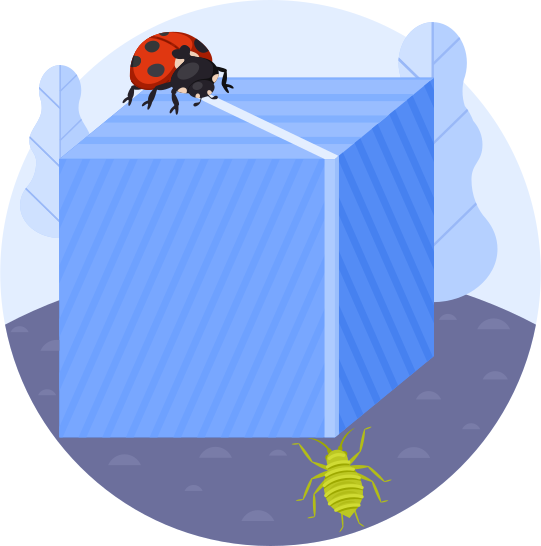
The 3D piece has been produced from a regular cube made of steel. How much does the piece weigh if the cube weighed 250 grams? All 6 openings on the sides are through holes.

Two Fathers, Two Sons

Two fathers and two sons on their way to Bombay found 3 silver rupees. They swiftly split the coins without any quarreling - each one received a whole coin. It happened due to the fact one of the travelers was...

What's in the Top Crate?

Draw a pictogram which should go in the top crate in order to complete the overall sequence.

How Many Brothers and Sisters? Part 2

A boy has as many sisters as brothers, but each sister has only half as many sisters as brothers. How many brothers and sisters are there in the family?

Grandpa and Lollypops

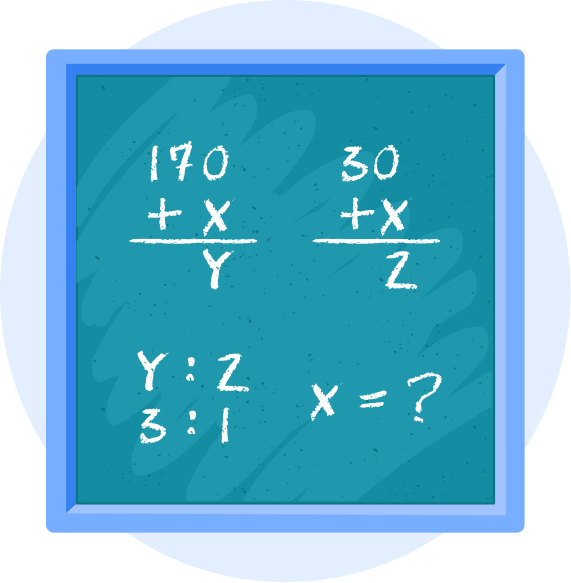
Before allowing his grandchildren eat the lollypops he just bought, the grandpa posed a challenge to divide the lollypops into 2 parts, so that the smaller part, multiplied by 4, would be equal to the larger part, divided by 3. What are the parts?

Seven Pets

An animal lover has seven pets. Some are cats, the rest are dogs. Each dog eats five biscuits and each cat four biscuits. 32 biscuits in all are eaten. How many dogs and how many cats are there?

How Many Brothers and Sisters?

In a family, each sibling has at least one brother and one sister. What is the smallest possible number of children in such a family?

A Herd of Cows

A mathematician counted 70 cows in the pasture. “What part of the whole herd are these cows?” - the mathematician asked the shepherd. “I brought in two-thirds of the third of the whole herd to graze,” - replied the shepherd. How many cows are there in the whole herd?

Puzzle Classics are timeless brain teasers that have captivated generations of players worldwide. These traditional puzzles challenge your intellect, creativity, and problem-solving skills through various formats and difficulty levels. From logic grids and spatial reasoning to word play and mathematical challenges, classic puzzles offer something for every type of thinker.


Classic puzzles develop critical thinking abilities that are valuable in everyday life. The beauty of these puzzles lies in their elegant simplicity combined with deep complexity - what appears straightforward at first glance often reveals hidden layers of challenge upon closer examination. Solving classic puzzles requires patience, attention to detail, and the ability to see patterns and connections that aren't immediately obvious.


Traditional puzzles stimulate multiple areas of the brain simultaneously. Whether you're deducing solutions through logical elimination, visualizing spatial relationships, or finding creative workarounds, you're giving your cognitive functions a comprehensive workout. Classic puzzles enhance memory retention, improve concentration, and develop systematic thinking approaches that can be applied to real-world problems.


Mastering classic puzzles builds confidence and resilience. The satisfaction of solving a challenging puzzle after careful analysis and multiple attempts provides a genuine sense of accomplishment. This positive reinforcement encourages persistence when facing difficult tasks in other areas of life, teaching valuable lessons about the rewards of sustained effort and strategic thinking.


Our extensive collection of interactive Puzzle Classics spans numerous categories and difficulty levels, making them perfect for both beginners and experienced puzzle enthusiasts. You can enjoy these timeless challenges repeatedly, discovering new insights each time, and share your favorite puzzles with friends and family members of all ages.


How to approach Puzzle Classics? While each puzzle type has its unique strategies, some universal principles apply. Read the instructions carefully - often the key to solving lies in understanding exactly what's being asked. Look for constraints and rules that might guide your approach. Don't be afraid to experiment with different methods, and remember that sometimes stepping away and returning with fresh eyes can reveal solutions that weren't apparent initially. Practice regularly - like any skill, puzzle-solving improves with consistent effort.


As an interesting historical note, here are 7 fascinating facts about classic puzzles:

- The oldest known puzzle is the "Stomachion," dating back to Archimedes around 200 BC;

- The Rubik's Cube, invented in 1974, has over 43 quintillion possible configurations;

- Sudoku, though associated with Japan, was actually invented by an American architect in 1979;

- Crossword puzzles first appeared in the New York World newspaper in 1913;

- The famous "Tower of Hanoi" puzzle was invented by French mathematician Édouard Lucas in 1883;

- Jigsaw puzzles were originally created as educational tools to teach geography to children;

- Logic puzzles have been used in psychological testing and entrance exams for decades due to their effectiveness in measuring reasoning ability.